
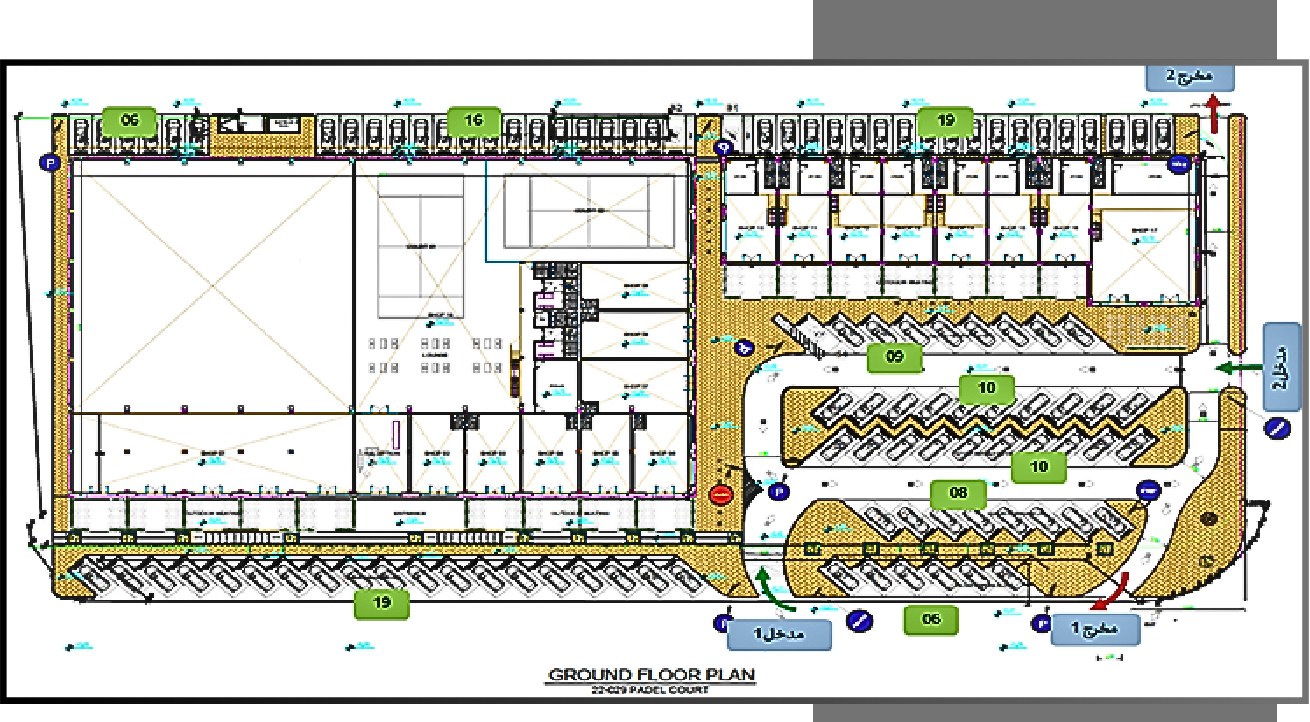
The short answer: there is no fixed price and no single timeline for every traffic impact study. Two things decide both: the study level set by the Procedural Guide for Traffic Impact Studies of Urban Development Projects (Ministry of Municipalities and Housing, final edition 2025), and how much has to be studied around your project. That is why at Cloud M&F (غيم موف) we scope your project's level free of charge before any quotation, so you know the cost and the timeline from day one.
Does my project need a study at all?
Under section 2.3 of the guide, a traffic impact study is required when the project generates more than 500 trips in the AM or PM peak hour, after deducting pass-by traffic. It can also be required at 500 trips or fewer if the project sits on a congested main corridor, differs from the land-use guidance plan, needs a traffic signal at its entrance or a separate intersection, or the Amanah, with the traffic directorate, judges that it harms road safety.
Page 12 of the guide also tabulates a minimum size that triggers a study by land use — for example large shopping centres from 4,500 m², banks from 600 m², gas stations from 1,200 m², and villas from 56 units.
First: the study level — the biggest driver of cost and time
Level 1 (100 peak-hour trips or fewer) is an access & egress study: entrance and exit design, on-site circulation and parking. It is the shortest and least expensive.
Level 2 (101 – 2,500 trips) is a traffic impact study: it adds capacity and level-of-service (LOS) analysis of the surrounding junctions and roads, with solutions for access, signals and lanes.
Level 3 (over 2,500 trips) is a comprehensive transport study: the guide requires a wider study area, a VISUM demand model and then detailed VISSIM simulation for the opening year and 20 years after. It is the longest and most expensive.
Second: what moves the cost within the same level?
The number of junctions and roads to study around the project; the number of traffic-count days and locations; whether analysis in tools such as Synchro and SIDRA is enough or a VISSIM simulation model is needed; how much has to be designed — a traffic signal, a deceleration lane, a roundabout or re-planned access; and how many review rounds the authority runs before approval.
How long does a study take?
Level 1 studies are the shortest: we delivered an access study for a gas station on Dhahran Road in Al-Ahsa in 12 days. A traffic impact study usually takes from two weeks to several weeks, depending on the number of junctions and the field counts. A comprehensive transport study takes longest, because the guide asks for a wider network model over a 20-year horizon.
Add to that the authority's review and comments until approval. That part is outside the consultant's hands, but submitting a complete study from the start shortens it.
What makes it longer and more expensive?
Starting after the design is finished instead of alongside it, so access changes redo part of the work; missing drawings or area and use data; traffic counts taken on days that do not reflect the real peak, so they are repeated; and extra review rounds when the authority's requirements were not met from the start.
How to save time and cost
Fix your project's level before the final design — we scope it for free. Have the site plan, areas and floor uses ready. Let one team prepare the study and follow the Amanah's comments through to approval. At Cloud M&F we prepare traffic impact studies in Dammam, the Eastern Province, Al-Ahsa and Riyadh and follow them through to approval — reach us on WhatsApp +966 55 988 5088.
Have a project? We are here.
Talk to us