
Transport & Traffic · October 19, 2026 · 6 min read
Traffic Studies for Gas Stations: Not Just a Licence Requirement, but What Makes Your Station Succeed
Many people see the traffic study as a document the Amanah asks for before the licence. In fact it is the first thing that decides whether your station succeeds: can drivers reach it easily? Can they get in and out safely? Can they find their spot without congestion? A driver who struggles at the entrance or gets stuck in a queue spilling onto the road may not come back. This guide explains why your station needs a traffic study, when it is required and what it covers, under the Procedural Guide for Traffic Impact Studies of Urban Development Projects (Ministry of Municipalities and Housing, final edition 2025).
Today's gas station is a service hub
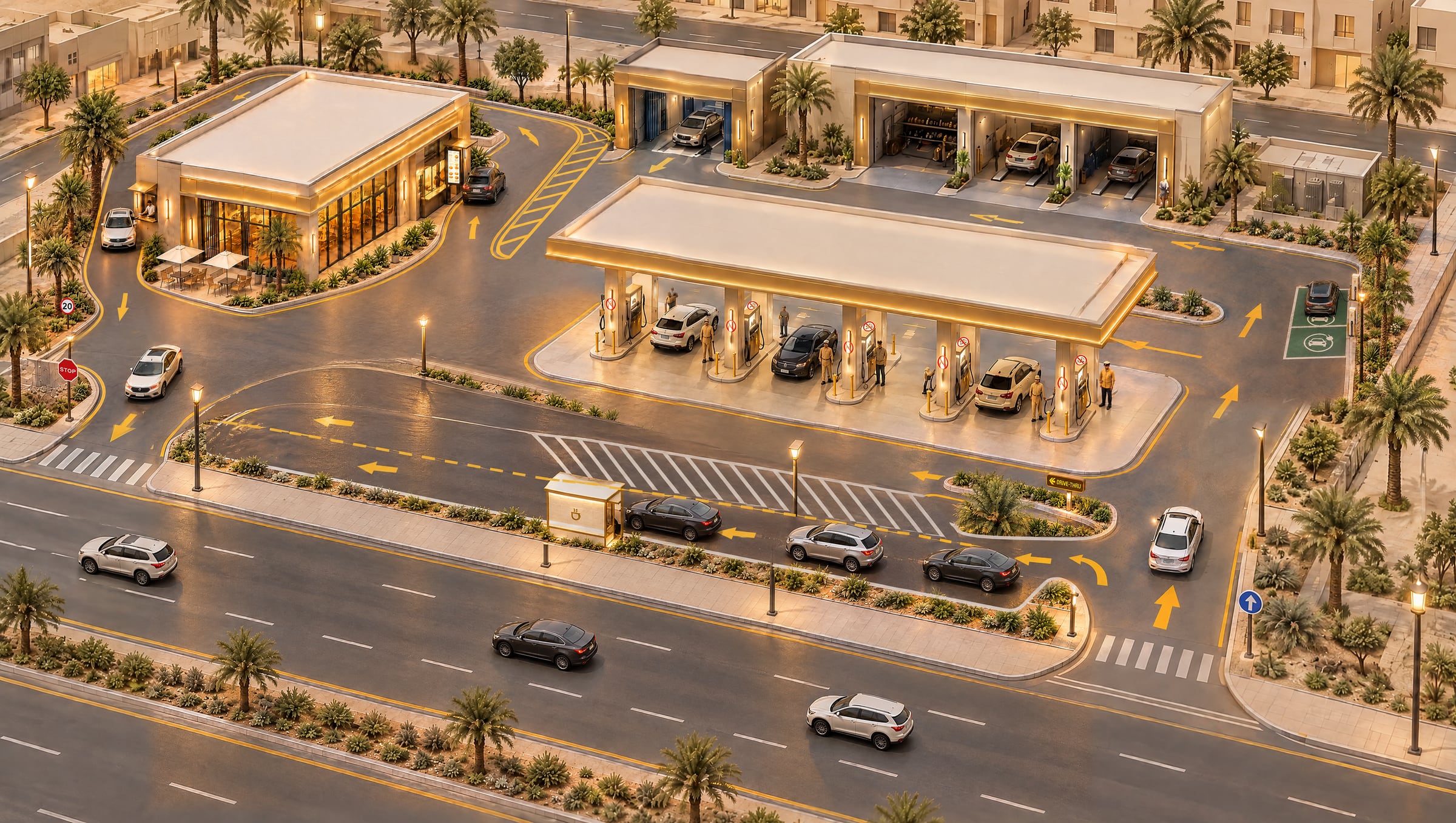
A station is no longer just pumps. Many modern stations across the Kingdom have become hubs that bring a district's services together: a supermarket, restaurants, cafés, drive-thru outlets, a tyre shop and a car wash.
Each service has its own traffic, and they all meet on one site: a car refuelling, another waiting in the drive-thru queue, a third heading into the car wash, and the fuel tanker unloading. Most problems start at the drive-thru: a queue that grows at peak hour, reaches the entrance and then the road, blocking the whole station and disrupting the street.
How a traffic study makes your station succeed
A traffic study organises all of this inside and outside the station: an entrance drivers see early and reach easily; separate lanes for fuel and services so one never blocks another; queues that stay on site however busy it gets; and a safe exit back onto the road.
The result is a station that is easy to reach, enter and leave, safe and smooth movement for your customers, and an experience that brings them back. The licence then follows naturally from a good study; it is not the goal.
When is a study required?
Page 12 of the guide tabulates a minimum size that triggers a study by land use, and for gas stations it is 1,200 m².
The general rule in section 2.3 still applies: a traffic impact study is required when a project generates more than 500 trips in the peak hour after deducting pass-by traffic, and gas stations are a special case because many of their customers are cars already passing on the road. A study can also be required below that threshold if the station sits on a congested main corridor, needs a traffic signal at its entrance, or the Amanah, with the traffic directorate, judges that it affects road safety.
Which level does your station need?
A small station with its pumps and convenience store usually falls under Level 1 (100 peak-hour trips or fewer), so its study is an access and egress study. A service hub with a restaurant, drive-thru and car wash can generate more trips and move up to Level 2, a traffic impact study with capacity and level-of-service analysis of the surrounding junctions. Trip generation decides, and we scope your level free of charge before we start.
What does the study cover?
Outside the station: the position of the entrance and exit and their distance from nearby junctions and accesses, and deceleration and acceleration lanes where the road needs them.
Inside the station: circulation without conflicting paths; queue length at the pumps and in the drive-thru so it never reaches the road; car wash and tyre shop lanes; the fuel tanker's route and turning space without blocking customers; parking and pedestrian movement to the shops; and signage and road markings.
The result is an access plan and a report you submit to the Amanah as part of the licence file.
What we need from you to start
The land deed or survey sketch, the station's preliminary layout (number and position of pumps, support services and their areas), the proposed access points if you have them, and any earlier comments from the Amanah. If the design is not final yet, that is the best time to start: running the study alongside the design avoids redrawing the accesses later.
How long does it take?
Level 1 studies are the shortest: we delivered an access study for a Transit gas station on Dhahran Road in Al-Ahsa (13,481 m²) in 12 days. Add the Amanah's review and comments until approval; that is outside the firm's control, and it is shorter when the study is complete from the first submission.
Our gas station experience
We have prepared a series of access studies for full-service gas stations across the Eastern Province, Al-Ahsa and Riyadh, for brands such as AlDrees, Orange, Transit and Petromin. We serve projects across the Kingdom and follow our studies with the competent authority through to approval. Cloud M&F (غيم موف) is certified to ISO 39001 for road traffic safety management.
Next step
Send us your station's location, area and planned services on WhatsApp at +966 55 988 5088, and we will tell you free of charge whether you need a study, which level, and the expected timeline, before any quotation.
Companies we have served


Have a project? We are here.